Four years. That's your wait between World Cups. Feels like forever when your team just won. Feels even longer when they didn't.
But why four years specifically? Not two. Not six. Four.
Turns out there are real reasons. Several of them. And they go back much further than you probably think.
The Original Reason the FIFA World Cup Is Every 4 Years
Olympic model. That's where it starts.
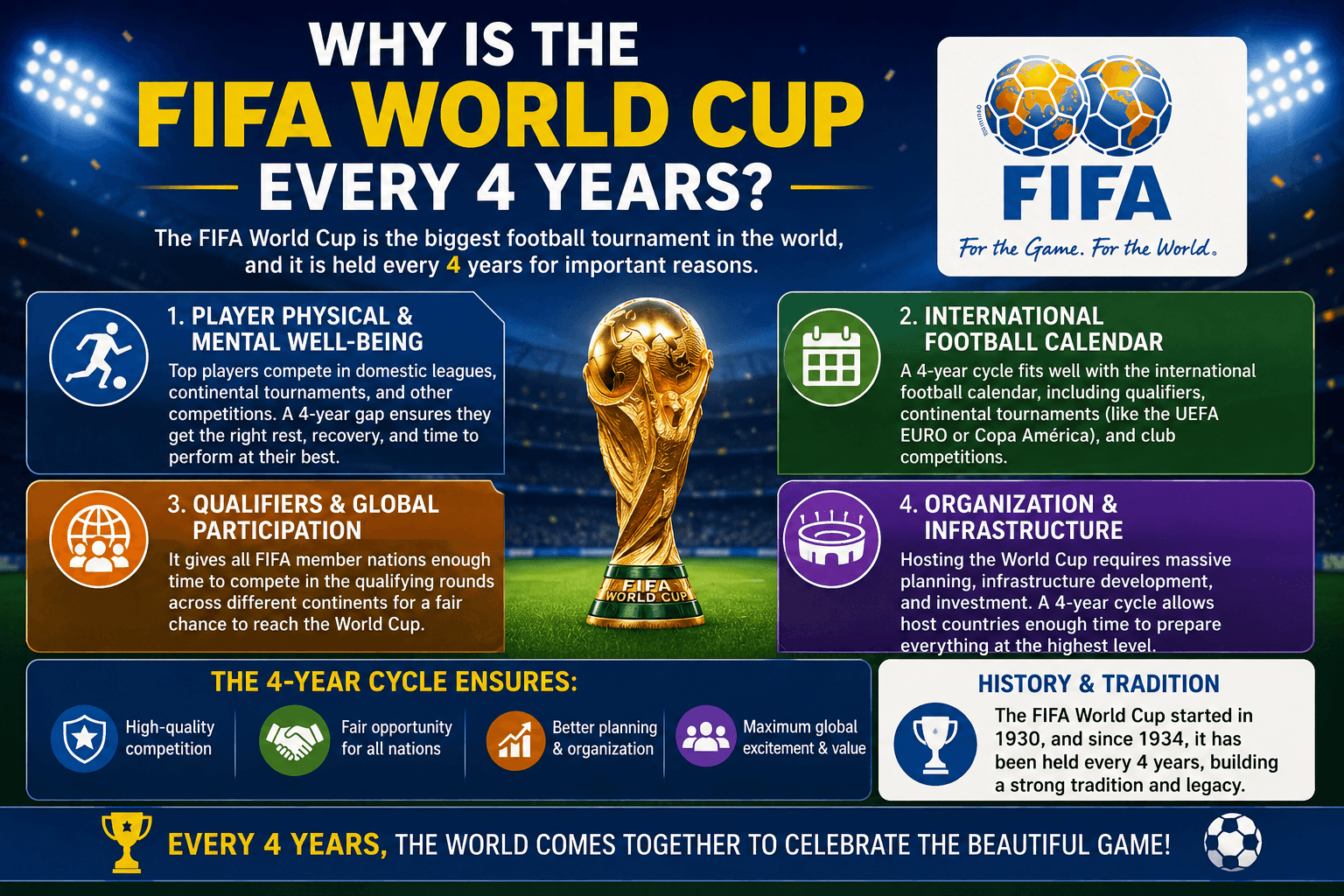
When FIFA held the first proper World Cup in 1930 in Uruguay, the Olympics already ran on a four-year cycle. International football had been part of the Olympics since 1900. Organising a separate tournament every four years made practical sense. It fitted the rhythm the sporting world already understood.
Jules Rimet, the FIFA president who championed the creation of the World Cup, designed it around that same framework. Four-year gaps. Global rotation. One host nation at a time.
Nobody sat in a room and decided four was the magic number. It grew organically from what already existed.
The Practical Reality That Keeps It at Four Years
Try running a FIFA World Cup every two years and see what falls apart.
First: qualifying. The 2026 World Cup qualification ran across six confederations over roughly two years of matches. UEFA alone played hundreds of qualifying games across Europe. CONMEBOL, CAF, AFC, CONCACAF, and OFC all ran similar processes. You need time to do this properly. Compress it, and you rush the entire foundation.
Qatar started serious preparations in 2012 for the 2022 tournament. That's ten years. Host nations simply cannot do this every two years.
Third: player welfare. Elite footballers at clubs like Real Madrid, Manchester City, and Bayern Munich already play 55 to 70 matches per season. Add international windows, continental tournaments in the off-years like the Euros and the Copa America, and they're at the absolute physical limit already.
Why the FIFA Cycle Actually Benefits Football
Scarcity is the point. Not the problem.
Because the World Cup comes around every four years, it genuinely means something when it arrives. The 2022 Qatar tournament broke global viewership records. The 2026 edition in North America is tracking ahead of that. Fans wait. Anticipation builds. The emotional investment over four years of qualifying creates a connection to the tournament that a more frequent competition simply couldn't replicate.
Compare it to club football, which happens every week. People still care deeply. But a Champions League final doesn't carry quite the weight of a World Cup final. Part of that is the national identity element. Part of it is the rarity.
Also worth knowing: FIFA did explore a two-year World Cup proposal recently. The idea was floated around 2021 by European football development chief Arsène Wenger. UEFA and CONMEBOL both strongly opposed it. It was dropped. The arguments against, primarily around player welfare and the devaluation of qualifying, were considered too significant to ignore.
Following the FIFA World Cup on Lotus365
Lotus365 carries live World Cup betting markets across every knockout match, from match winner and goalscorer props through to outright tournament winner odds. UPI deposits process instantly, and IMPS withdrawals average 5 to 40 minutes.
Final Thoughts
Four years. It's tradition, logistics, player welfare, qualifying complexity, and the deliberate creation of something rare enough to matter. The FIFA World Cup every four years isn't arbitrary. It's the one schedule that actually works.