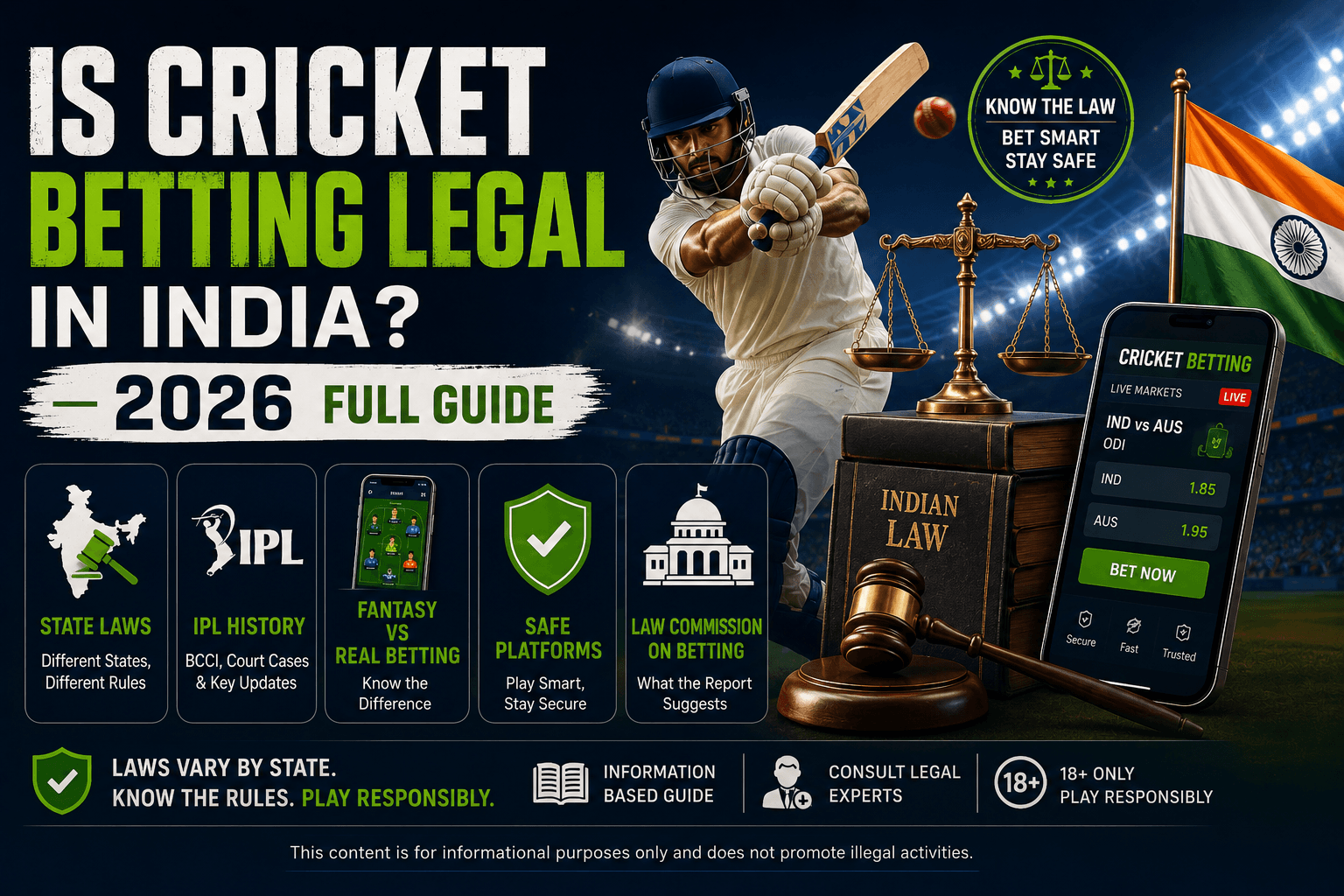
Complete State Laws and Online Safety Guide
Whether cricket betting is legal in india is one of the most searched questions among Indian sports fans, and the answer demands more than a simple yes or no. The legal position on cricket betting in India involves three layers: central legislation that predates the internet, state-level laws that vary widely, and a growing body of court rulings that have begun to distinguish between different types of cricket-related gaming. Understanding all three layers is what separates an informed decision from a guess.
This guide is specifically about cricket betting india laws, not general gambling law. Cricket has a unique place in Indian sports culture and law. The 2013 IPL spot-fixing scandal triggered national debate, a Law Commission report recommended legalisation in 2018, and fantasy cricket platforms have won multiple court victories on skill-game grounds. The situation for real-money online cricket betting on match outcomes through offshore platforms sits at the intersection of all these developments.
This guide covers the central legal framework, the state-by-state picture, the historical IPL context, the critical distinction between fantasy cricket and real-money betting, how to verify a safe offshore platform, and what the law says about individual users rather than operators.
This guide is for informational purposes only and does not constitute legal advice. Laws change. For advice specific to your state and situation, consult a qualified Indian legal professional with expertise in gaming and technology law.
Trust Signal Box Last Updated: May 2026 Legal Sources Referenced: Public Gambling Act 1867, IT Act 2000, state Gaming Acts, Law Commission 276th Report 2018, High Court rulings 2017-2023 Reviewed By: Lotus365 editorial team
The Direct Answer: Is Cricket Betting Legal in India?
For most Indian states: placing a cricket bet on an offshore licensed platform exists in a legal grey zone. There is no central Indian law that explicitly bans individual residents from using offshore licensed betting platforms for cricket. There is also no central law that explicitly legalises it.
Several individual states have enacted specific legislation that restricts or prohibits online gaming within their borders. In these states, the grey zone becomes a clearer legal risk. In most other states, the situation remains ambiguous under laws that predate digital technology entirely.
The practical position for most Indian cricket bettors: individual users accessing offshore licensed cricket betting platforms have not faced central-government prosecution specifically for placing bets. State-level enforcement varies significantly. The safest legal position is to be in a state that has not enacted specific restrictions and to use a licensed offshore platform rather than an unregulated one.
Three Laws That Shape Cricket Betting Legality in India
The Public Gambling Act 1867
The Public Gambling Act of 1867 is the oldest and most frequently cited gambling law in India. It was enacted to regulate physical gambling houses and common gaming rooms in British India. It has never been amended to address internet activity.
The Act prohibits operating or being found in a common gaming house and covers games of chance played for money in physical locations. It makes no reference to online activity, offshore platforms, smartphone applications, or sports betting conducted through digital channels.
Most state-level gambling laws in India derive from or mirror the Public Gambling Act. They carry the same limitation: enacted before digital sports betting existed, they do not directly address it.
The Information Technology Act 2000
The IT Act governs electronic transactions, cybercrime, and online content in India. Section 67 prohibits obscene online content. Sections 43 and 66 cover unauthorised computer access and data theft. The Act does not contain any provision that specifically prohibits placing cricket bets through offshore platforms.
No case law exists as of 2026 where an individual Indian resident was successfully prosecuted under the IT Act specifically for placing a cricket bet through an offshore licensed platform.
Games of Skill vs Games of Chance
The most legally significant distinction in Indian gaming law is between games of skill and games of chance. The Supreme Court of India established in 1996 that horse racing is primarily a game of skill, creating a legal pathway for skill-based gaming activities to operate with greater protection than pure chance games.
This distinction has been the central argument in the legalisation of fantasy cricket. Multiple High Courts have ruled that fantasy cricket requires substantial skill in player selection, team composition, and strategic management of a virtual budget. This makes it a game of skill, not chance, under Indian law.
Real-money cricket betting on match outcomes is typically treated differently from fantasy cricket under this framework. Betting on a match winner, session total, or player milestone is more commonly classified as a chance-based activity rather than a skill-based one, though no definitive Supreme Court ruling has addressed this specific question for online offshore betting.
The IPL and Cricket Betting: A Turning Point
The 2013 IPL Spot-Fixing Scandal
The 2013 IPL spot-fixing scandal brought cricket betting into national public debate with unprecedented intensity. Multiple cricketers and team officials were found to be involved in spot-fixing arrangements, where specific events within matches were predetermined for betting purposes. The Supreme Court of India appointed the Justice Lodha Committee to investigate and recommend reforms.
The scandal’s aftermath created two competing narratives. One camp argued the scandal proved that illegal underground betting was corrupting cricket and that legalisation with regulation was the only solution. The other argued it proved that betting should be suppressed entirely. The legal framework has not definitively resolved this debate.
The Law Commission’s 2018 Recommendation
The Law Commission of India’s 276th Report, released in 2018, is the most significant legal document on Indian sports betting. The Commission conducted extensive research and recommended regulated, licensed sports betting as superior to prohibition that drives activity underground.
The Commission specifically noted that cricket betting in India already existed at enormous scale through underground and offshore channels, and that regulation would generate tax revenue, protect consumers, and reduce corruption risks. The report recommended a federal sports betting framework with state-level opt-in mechanisms.
As of 2026, no central legislation has implemented these recommendations. The report remains influential in legal and policy discussions but has not yet changed the law.
BCCI’s Official Position
The Board of Control for Cricket in India (BCCI) does not officially endorse cricket betting. The BCCI has anti-corruption protocols in place and works with national anti-corruption units. At the same time, the BCCI has not publicly campaigned against regulated betting and has not taken a definitive public stance on the Law Commission’s legalisation recommendation.
Fantasy Cricket vs Real-Money Cricket Betting: The Legal Distinction
This is the most important distinction for Indian cricket fans to understand, and it is frequently misunderstood.
Fantasy Cricket (Dream11, MPL, and Similar Platforms)
Fantasy cricket platforms allow users to create virtual teams of real cricketers and score points based on those players’ actual match performances. Multiple High Courts across India (Punjab and Haryana, Rajasthan, Bombay) have ruled that fantasy cricket requires substantial skill in player selection and team management, making it a game of skill rather than chance.
Fantasy platforms like Dream11 operate Indian domestic licences, comply with Indian regulations, and are treated differently from offshore betting operators. Their legal position is materially clearer than offshore cricket betting platforms.
Real-Money Cricket Betting on Match Outcomes
Real-money cricket betting on specific match outcomes (match winner, session total, top batsman, first wicket method) through offshore platforms is not the same as fantasy cricket under Indian law. It is more commonly classified as a chance-based activity rather than skill-based, although no definitive Supreme Court ruling specifically addresses offshore cricket betting.
Offshore platforms serving Indian users operate under international licences (such as Curacao eGaming) and serve Indian users in the grey zone described above: neither explicitly legal nor explicitly illegal under central law in most states.
How to Identify a Safe and Legal Cricket Betting Site
Given the grey zone reality, platform safety is the practical protection available to Indian cricket bettors. A licensed, regulated offshore platform provides meaningful player protections even in the absence of domestic legalisation.
Use these five checks before depositing on any platform:
Check 1: Verify the licence number. Find the Curacao eGaming or equivalent licence number in the platform’s footer and confirm it on the official registry. An unverifiable licence is a red flag.
Check 2: Confirm SSL encryption. The padlock icon in your browser bar and HTTPS in the URL confirm that your data is encrypted. Use only platforms where this is present on every page including deposit and login screens.
Check 3: Confirm KYC requirements. Legitimate licensed platforms require PAN and Aadhaar identity verification for withdrawals. Platforms without KYC requirements have no accountability framework.
Check 4: Test support before depositing. Contact the support team before putting money in. A response within 5 minutes in Hindi or English indicates a functioning operation.
Check 5: Try a small deposit and withdrawal. Deposit ₹200, make a small bet, and request withdrawal of the remaining balance. A 15 to 30-minute UPI withdrawal confirms the platform actually pays out.
Lotus365 passes all five checks: verified Curacao licence, SSL on all pages, PAN and Aadhaar KYC, 24/7 Hindi and English support, and UPI withdrawals averaging 15 minutes in our tests.
Responsible Cricket Betting
Whether or not cricket betting becomes formally legalised in India, the financial risks remain the same. Set strict deposit limits before every match. Never bet money you cannot afford to lose. Avoid chasing losses after a bad session. If betting is affecting your finances, relationships, or work, seek help.
Contact iCall at 9152987821 or visit BeGambleAware.org for confidential support. You must be 18 or older to bet on Lotus365.
Explore Cricket Betting on Lotus365
For Indian bettors in states where offshore platforms are accessible, Lotus365 offers the deepest cricket betting market available:
- IPL Betting for every match with 100+ markets and live session betting
- Football Betting for EPL, ISL and Champions League
- Tennis Betting for Grand Slams and ATP/WTA
- Kabaddi Betting with live PKL raid markets
- Basketball Betting for NBA and EuroLeague
- MMA and UFC Betting for fight night markets
- Horse Racing including Indian Derby and RWITC
- Politics Betting for Lok Sabha and state elections
- Online Casino with Teen Patti, Aviator and 500+ games
- Sportsbook for all sports in one place
- Baseball Betting for MLB and World Series
- Table Tennis Betting for ITTF events
- Volleyball Betting for FIVB Nations League
- Ice Hockey Betting for NHL and KHL
- Rugby Betting for Six Nations and World Cup
- Darts Betting for PDC Championship events
- Futsal Betting for FIFA Futsal World Cup
- Greyhound Racing for UK and Irish events
- Binary Betting for simple yes or no markets
- Full platform at Lotus365
Know the Law, Bet Responsibly
The legal position on cricket betting in India is genuinely complex and continues to evolve. Most Indian cricket bettors use offshore licensed platforms in a grey zone that has persisted without central-government enforcement against individual players. The key protections available to you are choosing a properly licensed platform, verifying its credentials independently, staying within state-specific legal constraints, and betting only within your financial means.
Page reviewed: May 2026.