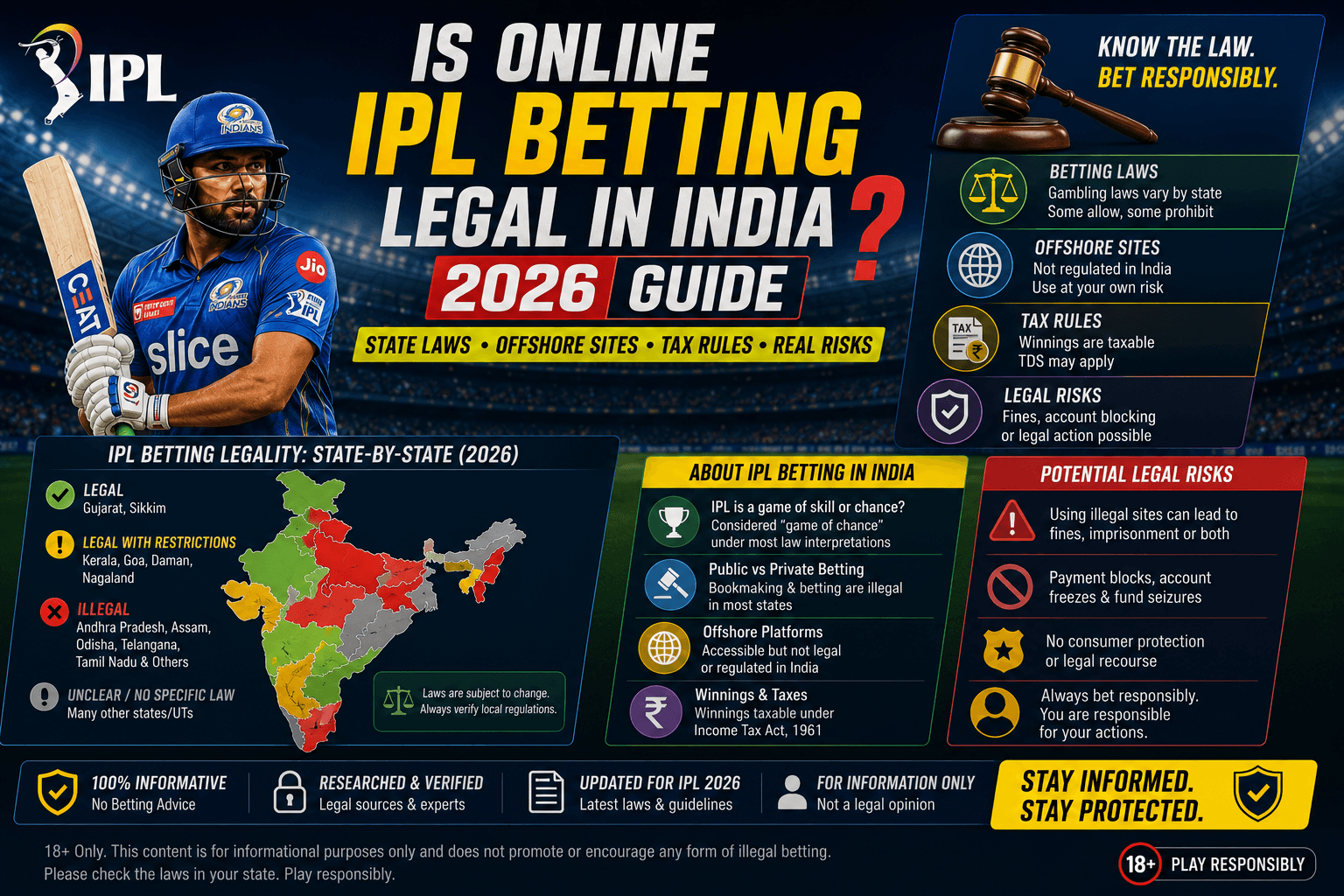
Online IPL betting sits in one of the most confusing legal positions in Indian consumer law. Central legislation predates the internet by more than a century. States have moved in different directions — some banning online betting outright, some carving out fantasy sports, some staying silent. The Supreme Court has repeatedly drawn a distinction between "games of skill" and "games of chance," and that single line determines what is legal where.
This guide answers the question Indian users actually search for: is online IPL betting legal where I live in 2026, and what are the actual risks if I bet anyway? It covers the central framework, the state-by-state position, what offshore-licensed operators mean for an Indian user, and the practical points — KYC, payments, taxation, dispute recovery — that determine real-world outcomes.
Online IPL betting is treated differently across India because gambling is a state subject under the Constitution. The same activity that is legal in Sikkim may be a criminal offence in Andhra Pradesh. Understanding which side of that line you sit on is the only meaningful starting point.
Is Online IPL Betting Legal in India? The Short Answer
There is no single yes-or-no answer because gambling regulation in India is fragmented across central and state law. Here is the most accurate one-paragraph summary:
Online IPL betting on offshore-licensed sportsbooks is in a legal grey area in most Indian states. It is explicitly banned in some states (including Andhra Pradesh, Telangana, Tamil Nadu's online gambling law, and others). India does not currently have a central licensing regime for online sports betting, which means no operator can be licensed to offer real-money IPL betting to Indian residents under domestic law. Most operators serving Indian users are licensed abroad — typically in Curacao or Malta.
That paragraph hides a lot of nuance. The rest of this guide unpacks it.
What Central Laws Govern Online IPL Betting in India?
Three pieces of central legislation form the backdrop for any gambling-related question in India. None of them was written with online IPL betting in mind, which is the source of most of the legal uncertainty.
What does the Public Gambling Act 1867 cover?
The Public Gambling Act 1867 is the central anti-gambling statute. It criminalises running or visiting a "common gaming house." Two important features:
It predates online activity by 130 years. It refers to physical premises, not websites.
It explicitly exempts "games of mere skill" from its scope. This exemption has become the single most important phrase in Indian gambling law.
Most states have either adopted the Public Gambling Act directly or passed their own gambling legislation modelled on it. The skill-versus-chance exemption travels into nearly all of these state laws.
How does the IT Act 2000 apply to online betting?
The Information Technology Act 2000 governs online activity. It does not explicitly ban online gambling, but Section 69A allows the central government to block public access to any online resource in the interest of "sovereignty, integrity, security or public order." The Ministry of Electronics and Information Technology has used this power against specific betting sites and surrogate-advertising channels.
Section 69A blocking order — a central government directive issued under the IT Act 2000 requiring internet service providers to block public access to specified websites. Several offshore betting operators have been targeted by such orders in recent years.
The Ministry of Information and Broadcasting has also issued advisories against surrogate advertising of betting platforms during IPL broadcasts. These are advisories, not bans on the underlying activity, but they signal the regulatory direction.
What is the game-of-skill versus game-of-chance distinction?
This is the most important legal concept in Indian gambling law and the reason fantasy sports and rummy operate openly while sportsbook betting does not.
Game of skill — an activity where the outcome is determined predominantly by the player's knowledge, judgement, or training rather than by chance. Under Indian law, games of skill are exempt from most gambling prohibitions.
Game of chance — an activity where the outcome is determined predominantly by random factors outside the player's control. Real-money games of chance are prohibited under most state gambling laws.
The Supreme Court of India has held in multiple judgments that horse racing, rummy, and fantasy sports (in their dominant formats) are games of skill. Pure sportsbook betting — wagering on whether a team will win an IPL match — is generally treated as a game of chance, because the bettor does not control the outcome.
This is why daily fantasy sports operators like Dream11 operate openly in most states while traditional IPL sportsbooks do not have a comparable legal foothold.
What About Offshore-Licensed IPL Betting Sites?
Most websites and apps that accept IPL bets from Indian users are licensed offshore — typically in Curacao or Malta. The legality of an Indian resident using such a site is a separate question from where the operator is licensed.
What is a Curacao gaming licence and what does it mean for Indian users?
Curacao eGaming licence — a gambling operator licence issued under the laws of Curacao, a Dutch Caribbean country. It permits the licensee to offer online gambling internationally, subject to Curacao's regulatory rules. It does not make the activity legal under any other country's law.
A Curacao licence regulates the operator's conduct under Curacao law. It does not give the operator legal authorisation to offer services in India. From the Indian government's perspective, an offshore-licensed operator serving Indian residents is operating outside the Indian regulatory framework, not within it.
What a Curacao licence does provide for the user:
- A basic dispute resolution mechanism through the Curacao regulator (in practice limited and slow).
- Audited random-number generators for casino-style products (less relevant for sportsbook betting).
- Segregation of player funds in many cases (though enforcement quality varies).
What it does not provide:
- Any legal recourse under Indian consumer protection law.
- Any protection against the operator being blocked in India under Section 69A.
- Any legal cover for the user against state-level prohibitions on online gambling.
Are users prosecuted for using offshore IPL betting sites?
As a general pattern in 2026: enforcement focuses primarily on operators, advertisers, and large-scale facilitators rather than individual recreational bettors. There are exceptions — most notably in states with active enforcement programmes such as Andhra Pradesh and Telangana, where FIRs against individual users have been filed.
This is a pattern, not a rule. "Most users are not prosecuted" is not the same as "using offshore betting sites is legal." The legal position is unchanged regardless of enforcement frequency.
What Are the Practical Risks of Online IPL Betting in India?
Beyond the legal question, there are practical risks that affect every Indian user of an offshore betting site. These exist regardless of which state you live in.
Payment and banking risks
The Reserve Bank of India has issued guidance to banks and payment processors restricting transactions with gambling operators. In practice this means:
- UPI deposits to betting sites may be blocked or reversed by the user's bank.
- Withdrawals can be flagged and held for review, sometimes for weeks.
- Cards issued by Indian banks are routinely declined at offshore gambling merchants.
- Bank accounts have been frozen following large or repeated deposits to gambling-coded merchants.
Tax obligations on IPL betting winnings
Winnings from betting and gambling are taxable in India under Section 115BB of the Income Tax Act. The applicable rate is currently 30% (plus applicable cess), levied on gross winnings — without any deduction for losses or for the stake. This applies regardless of whether the bet itself was placed legally.
Section 115BB — the section of the Income Tax Act 1961 that taxes winnings from lotteries, crossword puzzles, races including horse races, card games and other games of any sort, and gambling or betting of any form. The current rate is 30% on gross winnings.
Operators are required to deduct tax at source (TDS) on certain winnings under Section 194B and 194BA. Offshore operators may not deduct TDS, but the user's tax liability under Section 115BB is not removed by the operator's failure to deduct.
Failure to declare gambling winnings is a separate offence from any gambling-law violation.
KYC, account safety and dispute recovery
Offshore operators require KYC (Know Your Customer) verification before processing significant withdrawals. This typically means submitting:
- PAN card
- Aadhaar or another government-issued ID
- Address proof
- Bank statement or payment-method screenshot
Once submitted, this information is held offshore under Curacao or Malta data protection law — not under India's Digital Personal Data Protection framework. Recovery of these documents, or enforcement of data deletion, is in practice extremely difficult.
If an operator refuses a withdrawal, closes an account, or disappears entirely, an Indian user has limited recourse. Indian consumer courts generally do not exercise jurisdiction over offshore gambling operators, and Curacao's dispute resolution mechanism is slow and rarely results in financial recovery.
How Is Fantasy IPL Different From IPL Betting?
This distinction matters because fantasy sports occupy a different legal position to sportsbook IPL betting. Conflating them is one of the most common errors in Indian gambling commentary.
Daily fantasy sports (DFS) — a format where users select a virtual team of real players from upcoming matches, with the user's score determined by those players' real-life statistical performance. Operators like Dream11 and MyTeam11 use this format.
The Supreme Court and multiple High Courts have held that DFS in its dominant format is a game of skill — because the user selects players, assigns captains and vice-captains, and applies analytical judgement that materially affects the outcome. As a game of skill, DFS is exempt from most state gambling prohibitions.
Sportsbook IPL betting — wagering that Mumbai Indians will beat Chennai Super Kings — is treated differently. The user makes a prediction but does not exercise skill that affects the match outcome. Courts have generally treated this as a game of chance, falling outside the skill exemption.
This is why Dream11 operates openly and advertises during IPL broadcasts, while sportsbook operators do not. The two activities are not legally equivalent.
Responsible Gambling
Online IPL betting carries financial risk regardless of its legal status. Set a strict deposit limit before you start. Never bet money you need for essentials. If you find yourself betting to recover losses, betting more than you planned, or hiding bets from people who would be concerned, those are warning signs.
iCall (India): 9152987821 — confidential, free counselling, available in multiple Indian languages.
Conclusion: Know Your State Before You Bet
The honest position on online IPL betting in India in 2026 is that it is not affirmatively legal under Indian law and is explicitly banned in several states. Operators serving Indian users are licensed offshore and operate outside India's regulatory framework. Users carry the legal risk of their state's position, the practical risk of banking and KYC complications, and the tax obligation under Section 115BB regardless of the bet's legality. This is not a position a guide can paper over with reassurance. The single most important question for any Indian user is which state they live in and what their state's law currently says. The second is whether the practical risks — frozen accounts, slow withdrawals, no dispute recourse — are acceptable to them. The third is the tax obligation, which is not optional regardless of how the bet was placed. Page reviewed April 2026. Legal positions and state laws change frequently. Always verify with a current source before acting on any information in this article.