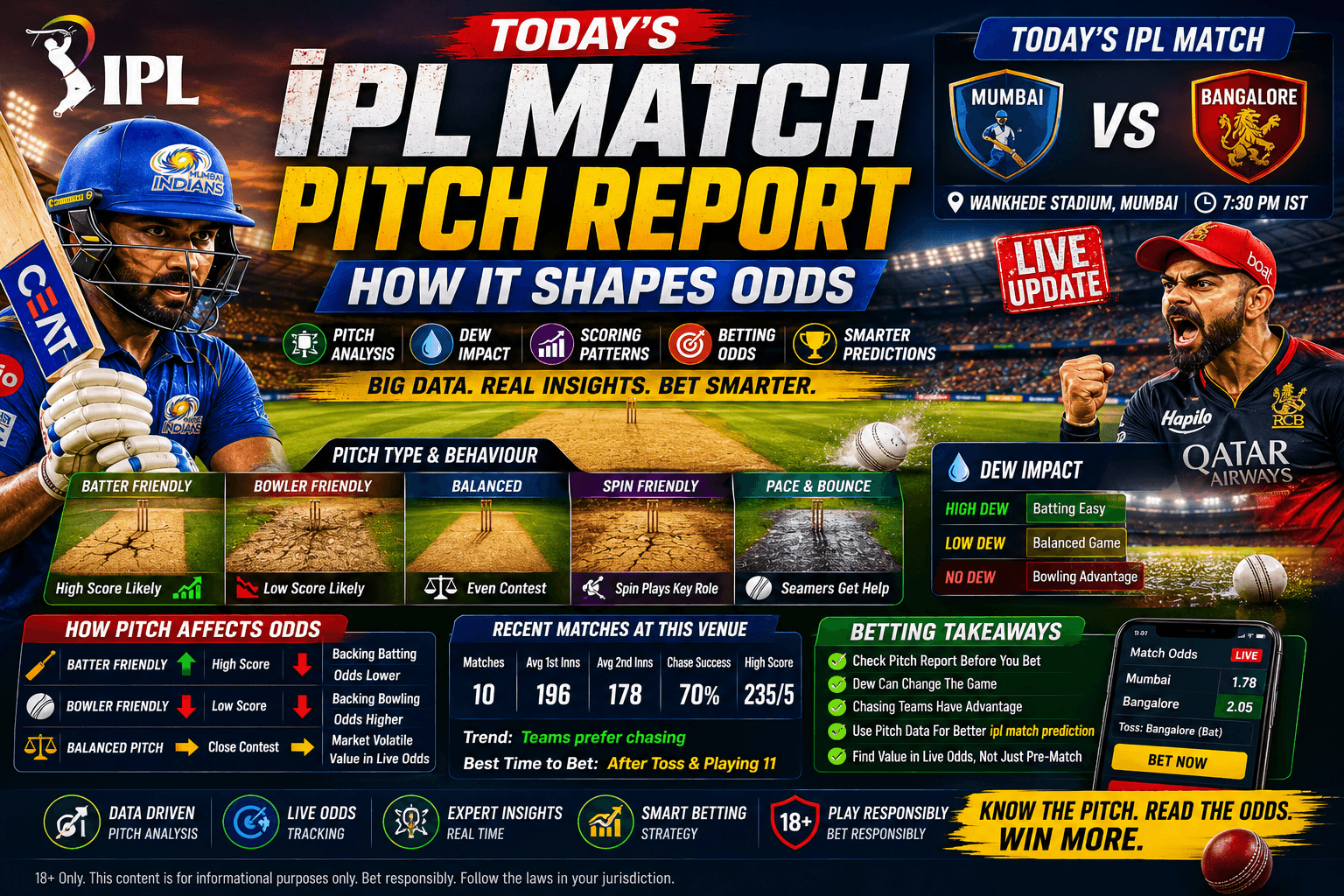
The pitch is the single most under-priced variable in IPL betting. Match-winner odds, total runs lines, top batsman markets, and Powerplay totals all swing on what the surface is doing — and yet most retail betting markets price the favourite based on team strength first and pitch behaviour second. That mispricing is where the structural edge lives for any bettor who can read a pitch report properly.
Today's IPL match pitch report tells you four things if you know how to read it: how high a par total is, which type of bowler will succeed, whether the toss matters more than usual, and whether the chasing side has an in-built advantage. Each of these maps directly to a betting market. None of them requires inside information — every piece of intel you need is in the broadcast pitch report, the venue's last five results, and the weather forecast for the next four hours.
This guide teaches you how to translate a pitch report into a numerical view of the match — the same translation that bookmakers' models do, but with a sharper read on Indian conditions and IPL-specific quirks that retail markets routinely miss.
What Is an IPL Pitch Report and What Does It Actually Tell You?
An IPL pitch report is a pre-match assessment of the playing surface, normally delivered by a former player on the broadcast 30–45 minutes before the toss. It typically covers grass coverage, soil type, hardness, cracks, expected wear, and the curator's stated intent. The good reports translate this into a number — an expected first-innings par score — and a tactical recommendation.
Par score — the expected first-innings total at the venue under current conditions, based on the last 5–10 matches played there in similar weather. A par score of 175 means a team scoring above 175 is statistically likely to win; below 175 is below average for that ground.
A useful pitch report tells you five specific things:
- Surface type — red soil, black soil, or a mix
2. Grass coverage — green, dry, or shaved
3. Hardness — how much carry the ball will get
4. Expected wear — how much the pitch will deteriorate by the second innings
5. Curator's intent — what kind of game the groundsman wanted
Each of these maps to a different betting market. Surface type and grass coverage drive the match-winner price. Hardness drives the boundary-count markets. Expected wear drives the chasing advantage. The curator's intent often tells you more than any of the others — particularly at home venues where the groundsman is preparing a surface to suit the home team.
How Does Pitch Soil Type Change IPL Betting Strategy?
Indian pitches are broadly split into red soil and black soil surfaces, with most IPL venues using one type predominantly or a mix. The soil determines how the pitch behaves — and the behaviour determines which bowlers succeed and where the value lies.
What is a red soil IPL pitch?
Red soil pitch — a pitch made from red murram-based soil, typical of the southern and western Indian belt. Red soil pitches are harder, offer more bounce, and tend to favour stroke-play. Bowlers get carry but less turn.
Red soil IPL venues — including Chinnaswamy (Bengaluru), Wankhede (Mumbai), and historically Chepauk (Chennai) — are predominantly batter-friendly. The ball comes onto the bat truer, edges carry to the keeper and slip cordon, and pace bowlers extract bounce. Par scores trend 175–185 on red soil surfaces in good weather.
Betting translation: On red soil pitches, total-runs and total-sixes "over" markets are usually priced fairly, but Powerplay-runs "over" markets and top-batsman opener markets often offer value. Spin-bowler top-bowler lines tend to be poor value — wrist-spinners struggle for purchase.
What is a black soil IPL pitch?
Black soil pitch — a pitch made from black cotton soil, found in central India and parts of the north. Black soil pitches are slower, grip the ball more, and tend to favour spin and cutters. Bounce is generally lower.
Black soil IPL venues — including parts of Pune (MCA), Chepauk in its slower mood, and Hyderabad in certain prepared conditions — produce lower-scoring matches. The ball holds in the surface, fast bowlers find their pace negated, and spinners get genuine turn from over 7 onwards. Par scores drop to 160–170.
Betting translation: On black soil pitches, total-runs "under" markets and top-bowler markets for quality spinners offer the best value. Chasing becomes harder because the pitch slows further in the second innings. Favourites that field a single spinner are over-priced; teams with two quality spinners are usually under-priced.
How do mixed pitches behave?
Several IPL venues use a mixed soil composition or rotate between two prepared strips. The Arun Jaitley Stadium in Delhi, MA Chidambaram in Chennai, and Eden Gardens in Kolkata all use mixed surfaces that behave differently depending on which strip is in play. The broadcast pitch report will normally identify which strip is being used — pay attention to that detail before forming a view.
How Do I Read a Live IPL Pitch Report?
The broadcast pitch report is delivered 30–45 minutes before the toss. It contains specific language that maps to specific cricketing outcomes — once you know the translation, you can convert a 90-second TV segment into a betting decision in seconds.
What does "good grass coverage" mean on a pitch report?
Good grass coverage — a green tinge across the strip — usually means three things: the ball will move sideways early, fast bowlers will extract more than usual in the Powerplay, and the toss winner is more likely to bowl first. Par scores drop by 10–15 runs versus the venue's average.
Betting translation: Total-runs "under" and wickets-in-Powerplay "over" markets become live. Match-winner odds usually adjust slowly to a green surface — favourites who bat first become value to underperform against the price.
What does "dry and dusty" mean on a pitch report?
Dry and dusty — a brown, shaved strip with visible cracks — means the surface will deteriorate, spin will become a major factor by overs 7–9, and chasing a large total will be very difficult on a wearing pitch. Par scores trend lower (160–170) but defended totals win more matches than usual.
Betting translation: The toss matters more on dry surfaces — the side batting first often wins because the pitch is at its best in the first innings. This is the opposite of the standard "chasing is good" assumption. If the favourite wins the toss and chooses to bowl, their price may have value lengthened.
What does "two-paced pitch" mean?
Two-paced pitch — a surface where the ball comes onto the bat at varying speeds — some balls hold up, others skid through. Two-paced surfaces are the hardest to bat on in T20 cricket and produce the lowest scores.
Two-paced pitches typically appear in venues with worn or repaired surfaces, or in the second half of the IPL season as ground use accumulates. They make timing the ball extremely difficult, and they favour cutters, slower-ball specialists, and wicket-to-wicket bowling over pace.
Betting translation: Total-runs "under" markets are strong value. Method-of-dismissal "caught" markets often shorten too much — bowled and LBW frequencies rise on two-paced surfaces.
What does "flat track" mean?
Flat track — a hard, dry, true surface with consistent bounce and no lateral movement. Flat tracks produce the highest IPL scores and the most dominant batting performances.
Flat tracks are the bookmaker's friend: scoring patterns are predictable and the standard models price these matches well. Par scores trend 190–200+, top-order batters dominate, and bowlers' economy rates explode in the death.
Betting translation: On flat tracks, look for value in markets that move slower than the match-winner: total-sixes "over", individual top-batsman lines on aggressive middle-order players, and Powerplay-runs "over" if either side has attacking openers.
How Do Dew and Toss Interact With the Pitch Report?
Dew is the variable that turns a marginal toss decision into a decisive one. The pitch report tells you what the surface will do for the first innings; the dew forecast tells you what happens to the bowling team in the second.
Dew — moisture that forms on the outfield and ball when air temperature drops to the dew point during a night match. Dew makes the ball wet and slippery, reducing grip for bowlers — particularly spinners — and making defending a total significantly harder.
When does dew make the chasing side a value bet?
Three conditions stack toward chasing value:
- Night match at a coastal or humid venue (Wankhede, Eden Gardens, Chepauk).
- Forecast humidity above 65% during the second innings window.
- Toss won by the bowling-first side.
When all three line up, the chasing team's match-winner price is usually shorter than it should be — but the total-runs "over" market often hasn't fully adjusted, because models price total runs primarily off the pitch report rather than the dew-adjusted bowling difficulty.
When does the pitch report override the dew advantage?
A dry, gripping pitch can neutralise the dew advantage even at a venue where dew typically appears. If the pitch is dusty and the curator's intent is to produce a wearing surface, the second-innings spin attack may still hold up against a wet ball — and the deteriorating pitch makes batting genuinely harder in the second innings.
This is the most commonly mispriced scenario in IPL betting: a known dew venue with a dry pitch report. Markets default to the dew narrative; the pitch can override it.
How Do I Use Today's IPL Pitch Report to Place a Bet?
Here is the practical workflow — the sequence to follow between the broadcast pitch report and the toss, which is where the highest-value pre-match decisions get made.
6. Watch the broadcast pitch report. Note the specific language used — green, dry, two-paced, flat. Note the par score the analyst suggests.
7. Cross-check against the venue baseline. If the report's par score is materially different from the venue's recent average, that is itself a signal — markets often anchor to the venue baseline.
8. Look at the venue's last match. Did the chasing side win? What was the score? Was dew a factor? Use this as the closest comparable.
9. Check the dew forecast. Humidity and temperature drop in the second innings window. If dew is forecast and the pitch report is consistent with a normal surface, the chasing side has an edge that may not be fully priced.
10. Identify which market reflects the pitch best. Match-winner is the most efficient market and the hardest to find value in. Total-runs, Powerplay-runs, and top-bowler markets usually price the pitch less efficiently.
11. Wait for the toss before placing the bet. Toss outcome moves the price meaningfully — placing pre-toss locks you in at a price that will shift in seconds.
The single biggest mistake retail bettors make is placing a match-winner bet before the toss. The toss carries 10–15% of the prediction weight; waiting for it is free information.
Responsible Gambling
IPL betting carries financial risk. Set a strict deposit limit before you start. Never bet money you need for essentials. If you find yourself betting to recover losses, betting more than you planned, or hiding bets from people who would be concerned, those are warning signs.
iCall (India): 9152987821 — confidential, free counselling, available in multiple Indian languages.
Conclusion: Read the Pitch, Read the Market
The pitch is the input most retail IPL betting markets price least efficiently. A bettor who can read today's pitch report — translate the language into a par score, identify which markets will be affected, and wait for the toss before acting — has a structural edge over the standard punter who bets on team strength alone. The framework is straightforward in outline: identify the soil and grass, identify the curator's intent, cross-check against the venue baseline, factor in the dew forecast, and place your bet in the market that prices the pitch worst. Combined with strict bankroll rules, this approach turns the pitch report from a piece of trivia into the most actionable 90 seconds of pre-match coverage on the broadcast.