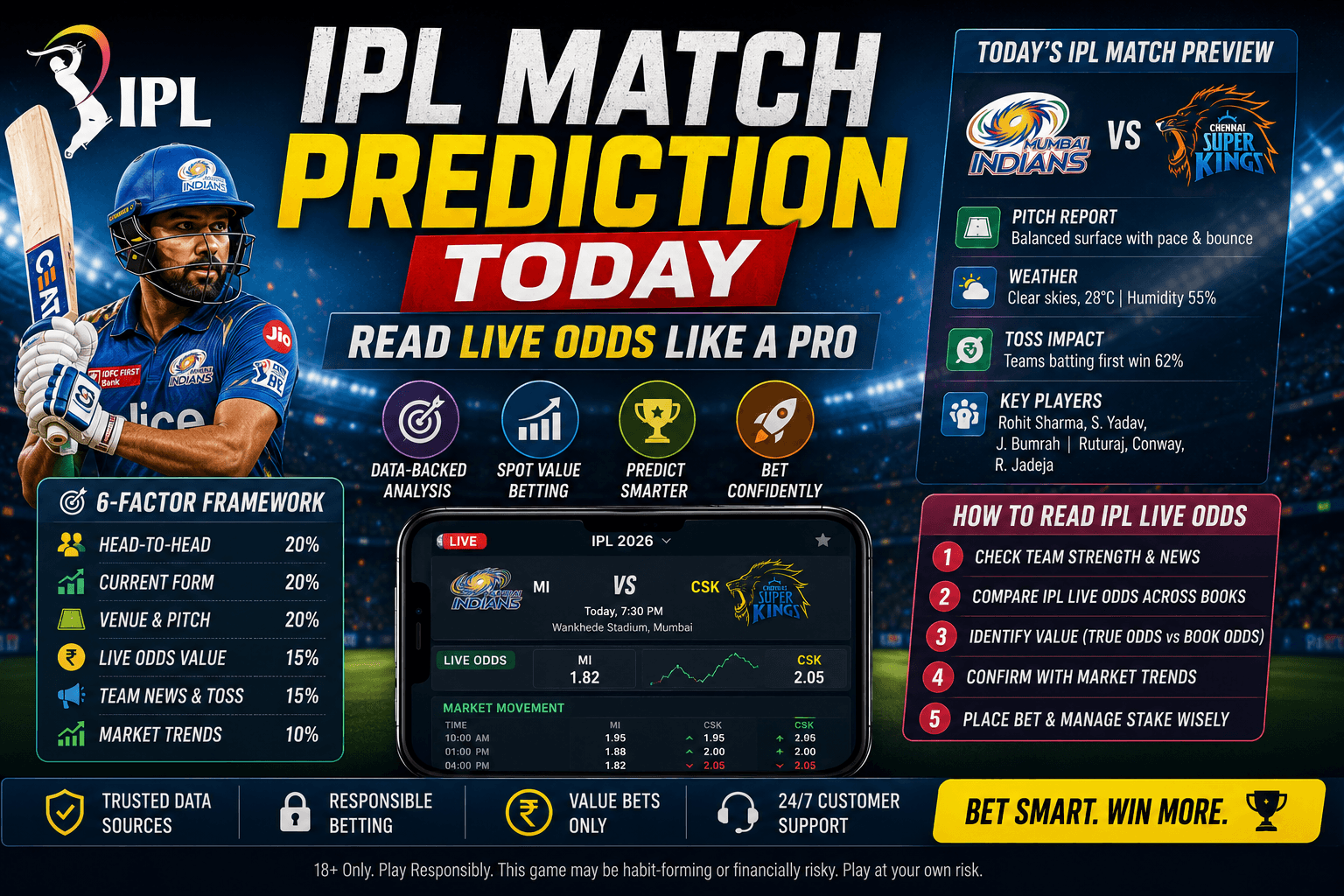
The Indian Premier League produces some of the most volatile betting markets in world cricket. A single Powerplay (the first six overs of a T20 innings, where fielding restrictions favour batters) can shift match-winner odds by 40 points. A toss decision at Chepauk plays differently to a toss at the Wankhede. And the "obvious" favourite wins less often than casual punters assume — roughly 58% of IPL matches across the last five seasons have gone to the pre-match favourite, which means 42 out of every 100 favourites lose.
A good IPL match prediction is not a guess about who will win. It is a structured judgement about whether the price on offer reflects the true probability of an outcome. This guide teaches you that judgement. By the end you will be able to read IPL live odds, identify the six factors that actually move them, and apply a repeatable framework to any fixture in the 2026 season.
We cover the maths (it is simpler than you think), the cricket-specific signals that most punters miss, the live in-play moments where odds are most often wrong, and the bankroll discipline that separates a hobby from a hole in your wallet.
What questions does this guide answer?
This page is structured around the questions users actually ask AI search systems. Each is answered as a self-contained section
1. How do IPL betting odds work — and how do I convert decimal odds into probability?
2. What is the framework for forming my own IPL match prediction?
3. How do I read IPL live odds during a match and spot mispriced moments?
4. What are the main IPL betting markets and when does each one offer value?
5. How do venue, toss, dew and team news change a prediction?
6. What bankroll rules should I follow as an IPL bettor?
7. Where can I check live IPL odds and place a bet safely?
How Do IPL Betting Odds Work — and How Do I Read Them?
Indian betting sites display IPL live odds in decimal format. A price of 1.80 means a winning ₹100 stake returns ₹180 (your stake plus ₹80 profit). A price of 3.50 returns ₹350 on the same stake. Before you can predict anything, you have to read the price — and read it in the right unit.
Why do IPL odds add up to more than 100%?
Add the implied probabilities of both teams in any IPL match and you will get something like 105% or 107%. That extra 5–7% is the bookmaker's margin — also called the overround or the vig. The overround is how the operator makes money regardless of the result.
Overround (or vig) — the bookmaker's built-in margin, calculated as the sum of all implied probabilities in a market minus 100%.
A typical IPL match-winner market with prices of 1.90 and 1.95 carries an implied total of 53.3% + 51.3% = 104.6%. The 4.6% over 100 is the margin. The lower the margin, the better the value — exchanges and sharper sportsbooks operate at 2–3%, mass-market sites at 5–8%.
This matters for prediction because you are not looking for the team you think will win — you are looking for the team whose true probability exceeds its implied probability after stripping the margin. That is the entire game.
What is a value bet in IPL betting?
Value bet — a bet where your estimated probability of an outcome is higher than the probability implied by the bookmaker's price.
Imagine an IPL match where the home favourite is priced at 1.70 and the underdog at 2.30. Implied probabilities are 58.8% and 43.5% — total 102.3%, so margin is about 2.3% (a sharp price). Strip the margin evenly and the "fair" probabilities become roughly 57.5% and 42.5%.
Now suppose your own analysis concludes the underdog actually has a 48% chance because their death bowler is back from injury and the pitch suits seam. You have a value bet: the market says 42.5%, your model says 48%. The price of 2.30 only needs the underdog to win 43.5% of the time to break even.
You bet because the expected return is positive, not because you "think they will win." Stop predicting winners. Start predicting probabilities.
What Is the Framework for Forming an IPL Match Prediction?
A reliable IPL match prediction weighs six factors. None is decisive on its own; the prediction emerges from how they stack. Work through them in order — they are listed by typical impact, with the highest-leverage factor first.
How does the venue and pitch affect IPL match prediction? (Weight: 25%)
The IPL plays at venues with radically different characters. A prediction that ignores the ground is missing its biggest variable. Pitch behaviour determines what kind of bowler succeeds, what a par score looks like, and which side of the toss has the edge.
Par score — the expected first-innings total at a given venue, based on the last 5–10 matches played there in similar conditions.
- High-scoring batting decks: Wankhede (Mumbai), Brabourne, Chinnaswamy (Bengaluru), Eden Gardens. Average first innings scores trend 180+. Favour batting line-ups with depth to seven.
- Slower, gripping surfaces: Chepauk (Chennai), Arun Jaitley (Delhi after relay), MCA Pune. Spinners get purchase, par scores drop to 160–170. Favour teams with two quality spinners.
- Pace and bounce: Mohali (PCA), Dharamsala. Seamers extract carry; wrist-spinners less effective. Favour pace-heavy attacks.
- Dew-affected venues: Wankhede night games, Eden night games, Chennai night games. Chasing wins approach 60% in heavy dew conditions because the ball skids on and bowlers struggle to grip.
Look up the venue's last five completed matches before forming a view. The numbers you want are the average first innings score and the win rate batting second.
How important is recent team form in IPL prediction? (Weight: 20%)
Recency matters more than season averages in T20 cricket. A side that has won three of their last four is in a meaningfully different state to one that has lost three of four, even if their net run rates over the season look similar.
Net run rate (NRR) — a team's runs scored per over minus their runs conceded per over across the tournament — used as a tiebreaker and a form indicator.
Two specific signals to track:
- Net run rate in the last 5 matches. This filters noise from one-sided results.
- Performance in the last meeting between these two teams. Head-to-head in the current season is more predictive than all-time records.
Avoid the recency trap: do not overweight a single hammering. A 10-wicket loss in a dew-affected chase tells you less than a close defeat in fair conditions.
How does team news and the playing XI change IPL live odds?
The biggest single-event mover of IPL live odds before toss is the team news leak. A confirmed absence of a top-four batter or a strike bowler can shift a match-winner price by 15–25 points within minutes. Live IPL odds adjust faster to team news than to almost any other input.
What to check 60–90 minutes before toss:
- Foreign player rotation. Teams are limited to four overseas players in the XI. A swap of a finisher for a bowler changes the run-rate ceiling and the death-overs strength simultaneously.
- Injury updates from the franchise's official channels and credentialed beat reporters (not aggregator accounts).
- Captaincy changes — a stand-in captain often makes more conservative bowling decisions in the death, which matters for total-runs markets.
If you cannot confirm the XI, hold your stake until you can. The toss usually arrives 30 minutes before the first ball; team sheets drop with the toss.
How much does the toss matter in IPL prediction? (Weight: 15%)
The toss is genuinely material in the IPL because chasing carries a real edge at most venues, especially under lights. Over the last three seasons, sides batting second have won approximately 53–55% of completed matches league-wide, with the number climbing past 60% at heavy-dew grounds.
A prediction made before the toss is incomplete. Always wait for:
8. Who won the toss
9. What they chose
10. Whether that choice aligns with conditions
If the favourite wins the toss and bats first at a chasing ground, their price should drift (lengthen). If they chase, it should shorten. Smart markets adjust within seconds; slower books take a minute or two — that gap is where some value lives.
Which batter-bowler matchups should I track? (Weight: 10%)
Beyond team-vs-team, T20 prediction increasingly hinges on specific batter-bowler matchups. A left-arm wrist-spinner against a top order of three right-handers is a different proposition to the same bowler facing two lefties up top.
You do not need a database. Two questions get you 80% of the value:
- Does either team have a left-arm pace option in the Powerplay? (Disproportionately effective against right-hand-dominant tops.)
- Does either team have a wrist-spinner who bowls the middle overs? (Wicket-taking spin in overs 7–14 is the single most predictive bowling variable in modern T20.)
How do weather and dew change an IPL prediction? (Weight: 10%)
Weather affects more than rain interruptions. A muggy evening in Kolkata means heavy dew from over 12 onwards. Dew turns even quality spin into hittable filth and makes defending a total far harder than the scoreboard suggests.
Dew point — the temperature at which moisture in the air condenses. When the air temperature drops to the dew point during a match, dew forms on the outfield — making the ball wet and harder for bowlers to grip.
DLS (Duckworth-Lewis-Stern) — the mathematical method used to revise targets when an IPL match is interrupted by rain. DLS often favours the chasing side.
Check the forecast for:
- Rain probability during the match window (DLS-adjusted targets are notoriously kind to chasing sides).
- Humidity and temperature drop between the innings — dew forms when air temperature reaches the dew point, not from humidity alone.
- Wind direction at coastal venues (Wankhede, Chepauk) where the shorter boundary swings outcomes.
How Do I Read IPL Live Odds During a Match?
Live IPL odds — also called in-play odds — are where the IPL gets technically interesting and emotionally dangerous. Markets update every ball, sometimes every dot ball. Reading them well requires knowing what the model is doing and where it gets things wrong.
Live odds (in-play odds) — prices offered by a bookmaker after the match has started. They update ball-by-ball based on the current score, wickets in hand, overs remaining, and run-rate momentum.
What inputs drive IPL live odds?
Every live IPL match-winner price is essentially the output of three inputs:
11. Current score and required run rate (RRR). If the chasing side needs 8.5 runs an over with 7 wickets in hand, their price will be near 1.80. The same RRR with 3 wickets in hand might be 3.50.
Required run rate (RRR) — the runs per over the chasing team needs to score to reach the target — calculated as runs needed ÷ overs remaining.
12. Resources remaining (overs × wickets). Modelled identically to DLS. Two wickets lost in the Powerplay matter more than two wickets lost in overs 12–13.
13. Recent run rate momentum. A four-over partnership at 12 an over compresses the price even if the required rate hasn't yet been overtaken.
When all three move in the same direction, the price moves sharply. When they conflict — say the chasing team has lost wickets but the required rate is comfortable — the price moves slowly. That gap creates the most common in-play opportunities.
When are IPL live odds most often mispriced?
Years of watching IPL markets surface five repeatable patterns where prices over- or under-react:
14. Wicket in the first over of a chase. Prices often overreact. A chase of 180 is still very alive at 5/1 after one over.
15. A boundary in the 18th over of a defended innings. Prices over-react in the other direction; bowlers still have two overs to bowl.
16. The strategic timeout. Some books freeze markets briefly; others let prices drift on inertia. Compare two books during the break.
17. DRS reviews on a wicket. If the on-field decision is "out" and DRS is pending, some markets briefly price as if the wicket has fallen.
18. Rain delays before the cutoff over. If the match is heading toward DLS, the team ahead on par becomes value at offered prices that haven't adjusted.
How often should I check live IPL odds?
Constant refreshing destroys judgement. Set a cadence:
- Once per over between overs 1–10.
- End of Powerplay (over 6).
- Strategic timeout (over 10 first innings, over 10 second innings).
- Every ball from over 16 onwards.
This rhythm matches the moments when prices actually move materially. Watching tick-by-tick in overs 2–9 mostly burns attention without paying for it.
What Are the Main IPL Betting Markets and When Does Each Offer Value?
A complete IPL betting strategy uses different markets for different conviction levels. Each market answers a different question and prices a different kind of insight. Here is a tour, with notes on where prediction edges typically live.
What is the IPL match winner market?
The match winner market is the headline market in IPL betting: you simply bet on which team will win. It is the simplest to read, but with the most efficient pricing — sharps and algorithms have been chewing on these prices for years. Use it for plays where your edge is broad (a strong view on conditions or a major team-news swing).
What is the top batsman / top bowler market?
The top batsman market asks you to pick the highest run-scorer in one innings for one team. The top bowler market does the same for wicket-takers. Prices for top-order batters are typically 3.50–5.00; openers carry the structural advantage of facing the most balls. Where the edge lives: middle-order batters at chasing venues, where they get more strike than their position suggests because openers are sent in earlier in big chases.
How do total sixes and total fours markets work?
Total match sixes and total match fours are over/under markets on the boundary count for the whole match. Pricing here often lags the venue model. A high-scoring venue with two big-hitting top orders and a short straight boundary is the textbook scenario for "over" on sixes.
What is the Powerplay runs market?
The Powerplay runs market is an over/under on the first six overs of one innings. Heavily venue-dependent. Where the edge lives: teams with attacking openers facing a Powerplay attack short of a strike bowler. This market often misses team-news adjustments faster than the headline match-winner price does.
What are session and fancy markets in IPL betting?
Session and fancy markets are India-specific over/under lines on innings-specific or over-specific totals — runs in overs 1–6, runs in overs 7–10, total wickets in an innings, and similar. They carry higher margins and lower liquidity than the main markets, but the lines move slower. Treat as supplementary, not core. Some operators offer richer fancy markets than others.
How Do Toss, Venue and Dew Change Your IPL Prediction?
The three conditions-side variables deserve their own deep dive because most prediction sites systematically under-weight them. These are the variables that move IPL live odds most predictably.
Does the team batting second win more often in IPL?
Yes — on average, sides batting second in IPL win roughly 53–55% of completed matches. But the "chasing wins everything" narrative is only half true. The numbers across recent IPL seasons:
- League-wide: sides batting second win 53–55% of completed matches.
- Dew-affected night venues: chasing wins rise to 58–62%.
- Day matches and dry venues: the edge disappears or reverses — Chepauk daytime matches actually favour batting first.
So "team chasing is good" is a default, not a rule. Always cross-check against the venue and start time.
How do I use IPL venue stats in my prediction?
Before any match, look up the venue's last five matches and calculate:
- Average first innings score
- Win rate batting first vs second
- Average winning total when defending
If a venue has produced an average first innings score of 195 and a 60% second-innings win rate, then a pre-match favourite that bats first on this ground should be slightly downgraded versus the same favourite chasing. The price might not reflect that.
How does dew affect IPL betting?
Dew is checkable and predictable: humid coastal venues at night, October matches more than April matches, second innings after 8pm local. If dew is forecast and the toss winner bats first, the chasing side becomes the value side regardless of which is the "better" team on paper. This is one of the few IPL betting signals that retail markets routinely under-price.
How Does the IPL Prediction Framework Work in Practice?
Here is the framework applied end-to-end. The match details are illustrative — no real fixture is being predicted.
Hypothetical: Mumbai Indians vs Chennai Super Kings, Wankhede, 7:30pm start, mid-April. Pre-match odds: MI 1.85, CSK 2.05. Implied probabilities: 54.1% MI, 48.8% CSK. Margin: 2.9%.
Step 1 — Venue. Wankhede in April, evening start. High-scoring, dew likely from over 12 onwards. Chasing edge probably +5–7% over neutral.
Step 2 — Form. Both teams 3-2 from their last five. Even.
Step 3 — Team news (released at toss). Suppose MI lose their first-choice death bowler to a side strain; replacement is an uncapped Indian quick. CSK at full strength. Significant downgrade for MI death-overs strength.
Step 4 — Toss. CSK win the toss and choose to bowl. Dew is forecast.
Step 5 — Matchups. CSK have a left-arm wrist-spinner who has been excellent in the middle overs. MI's top three are right-handed.
Step 6 — Conditions. Wind off the sea, shorter boundary on the offside.
Synthesis. Three of six factors now favour CSK relative to the pre-match price: toss, dew, MI bowling injury. None strongly favour MI. The fair price for CSK was 48.8% implied; the analysis pushes it toward 53–55%. CSK at 2.05 implies 48.8% — well below your revised estimate. Value bet on CSK at 2.05 if your bankroll rules permit.
This is what a prediction looks like. Not "CSK will win." Rather, "CSK's true probability is higher than the price suggests, so the bet has positive expected value."
What Bankroll Rules Should I Follow as an IPL Bettor?
You cannot prediction-your-way around a broken bankroll. Two rules cover 90% of what matters in IPL betting bankroll management.
Rule 1: Unit sizing. Decide on a "unit" of 1–2% of your total bankroll. A ₹10,000 bankroll means a unit of ₹100–₹200. A standard value bet is 1 unit. A high-conviction bet is 2 units, maximum. Nothing is ever worth more than 2 units, no matter how sure you feel.
Rule 2: Session loss limits. Before every match, decide the maximum number of units you will lose. When you hit it, you stop — for that match, for that day, for that tournament if you have to. This is the only rule that prevents tilt.
Tilt — the emotional state where a bettor abandons their normal rules and chases losses with larger or worse-value bets. Tilt is the single largest destroyer of bankrolls in T20 betting.
A bankroll that survives a season of IPL is the bankroll that compounds. Bankrolls that chase losses do not survive.
Where Can I Place IPL Bets?
Indian users typically access IPL betting markets through offshore-licensed operators, since domestic regulation does not provide for online sportsbook licensing in most states. Two operators that are commonly used by Indian bettors:
- Reddy Anna — accessible via the linked site.
- Fairplay — accessible via the linked site.
Important: Online betting sits in a legal grey area in India and is restricted or banned in several states (including Andhra Pradesh, Telangana, Tamil Nadu and others). Verify your state's current legal position before depositing. Always read each operator's terms, deposit/withdrawal conditions, and KYC requirements. This article does not constitute legal advice or an endorsement of any operator's regulatory standing.
Responsible Gambling
Betting on IPL is entertainment with financial risk. Set a strict deposit limit before you start. Never bet money you need for essentials. If you find yourself betting to recover losses, betting more than you planned, or hiding bets from people who would be concerned, those are warning signs.
iCall (India): 9152987821 — confidential, free counselling, available in multiple Indian languages.
Conclusion: Predict Probabilities, Not Winners
A reliable IPL match prediction is a probability call, not a winner call. The framework is simple in outline and demanding in practice: convert decimal odds to implied probability, weight the six factors that move IPL matches, and bet only when your number is meaningfully higher than the price. This article does not tell you who will win tonight, because no one can. What it does is give you the same analytical structure that disciplined punters and professional traders use — applied to IPL conditions, IPL betting markets and Indian context. Combine this framework with strict bankroll rules and a responsible-gambling mindset, and you will outperform the average punter not because you predict more winners, but because you bet at better prices.
Next steps:
- Bookmark this page and walk through the 6-factor framework before each match.
- Read our companion guide on how to read cricket betting odds for a deeper dive on the maths.
- Compare prices across two books before every bet to capture the best line.
- Page reviewed April 2026. Markets and odds change continuously — verify current prices and operator T&Cs before placing any bet.
Schema Markup Blueprint
Implement all five schemas on this page:
19. Article schema — headline matches H1, datePublished + dateModified (monthly refresh), author Person with sameAs to author profile, publisher Organization.
20. FAQPage schema — all 10 Q&A pairs, answers matching body text exactly, each ≤300 words.
21. BreadcrumbList schema — Home → IPL Betting → IPL Match Prediction Today.
22. HowTo schema — wrap the 6-factor framework as a HowTo with 6 named steps. Captures procedural fan-out ("how do I predict an IPL match").
23. DefinedTermSet schema — wrap the Glossary (Appendix A) as a DefinedTermSet with each row as a DefinedTerm. Captures definitional fan-out ("what is a value bet", "what is RRR", etc.).