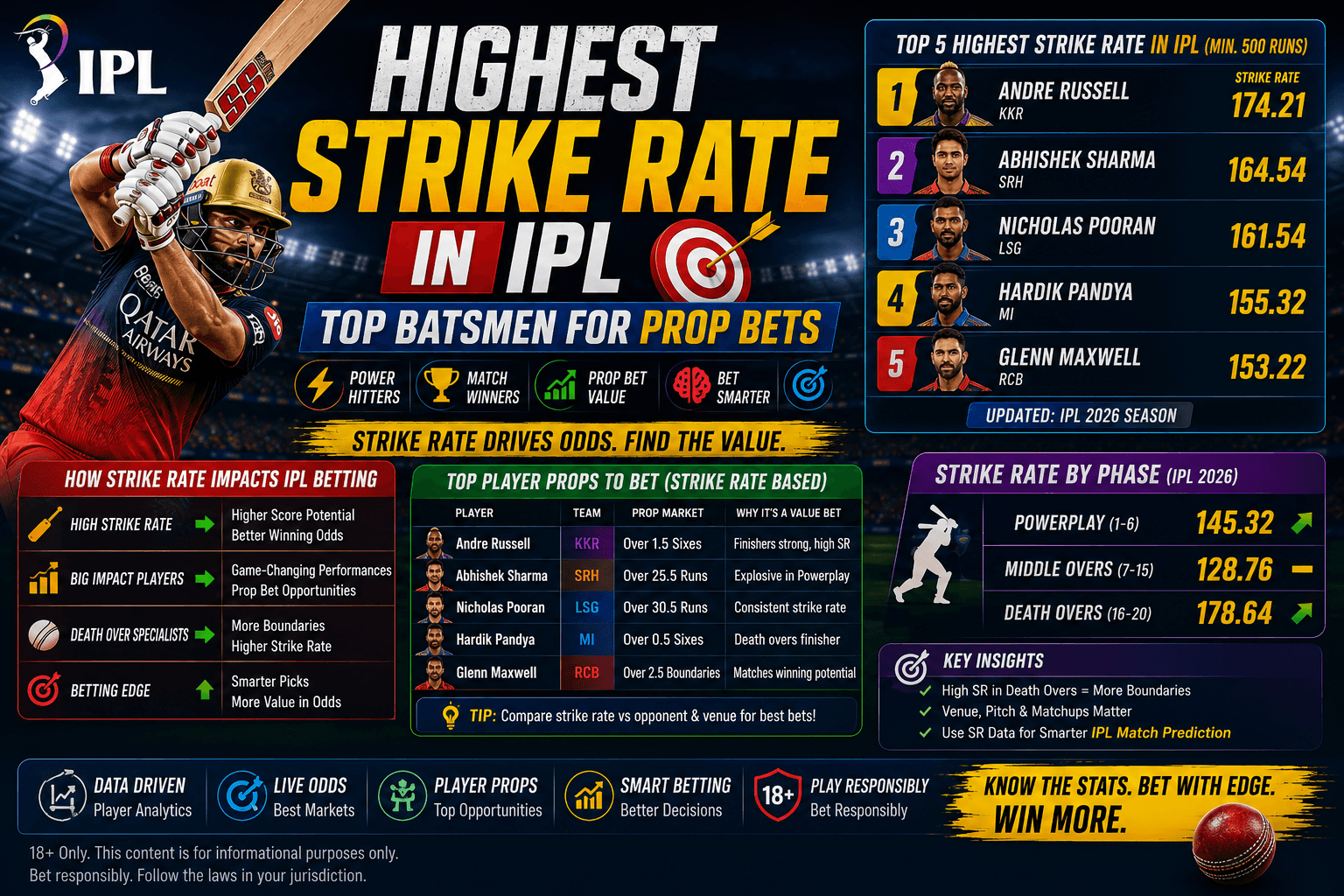
Strike rate is the single most useful number in IPL player prop betting. Average tells you how many runs a batter scores per innings; strike rate tells you how fast they get them — and in a format where every team has the same 120 balls to use, speed is what determines which batters make money and which ones don't. The highest strike rate in IPL history isn't a trivia number. It's the leading indicator for who covers a top-batsman line, who blows past a runs over/under, and who hits the sixes you're betting on.
This guide does two things. First, it explains how strike rate works in IPL prop markets — what it predicts well, what it predicts badly, and where the structural value hides. Second, it gives you a framework for picking high-strike-rate batters in any given match using batting position, venue, opposition matchup, and game state. Use it alongside the current-season top strike rate table, which your editorial team should refresh from a live stats source.
The article covers career strike rates (the historical anchor), single-season strike rates (the current form indicator), and contextual strike rates (Powerplay, middle overs, death overs — the numbers that actually drive prop pricing). It also covers the trap most punters fall into: backing the highest-strike-rate name on the team sheet without checking whether the match conditions support that player's scoring profile.
What Is Strike Rate in IPL Cricket and How Is It Calculated?
Strike rate (batting) — the number of runs a batter scores per 100 balls faced. Calculated as (runs ÷ balls faced) × 100. A strike rate of 150 means the batter scores 150 runs for every 100 balls they face — or, equivalently, 1.5 runs per ball.
In T20 cricket, strike rate is the dominant batting metric because the format constrains each team to 120 legal deliveries. A batter who averages 40 at a strike rate of 110 contributes less to a winning total than a batter who averages 28 at a strike rate of 160 — because the first is using up balls slowly while the second is using fewer balls per run. Strike rate captures the resource efficiency that average misses entirely.
How is strike rate different from batting average?
Batting average — total runs scored divided by the number of times the batter has been dismissed. Measures volume of runs per innings, not the speed at which they were scored.
Average rewards survival; strike rate rewards productivity per ball. A finisher batting at number six who scores 30 not out off 12 balls (strike rate 250) might never trouble the season's batting average leaderboard, but their contribution to winning T20 matches is enormous. Strike rate captures that contribution where average doesn't.
For prop betting, strike rate is almost always the more useful number. Top-batsman markets reward whoever scores the most runs in their team's innings — and the fastest scorer with sustained quality usually wins that battle, not the highest average.
Which Batsmen Have the Highest Career Strike Rate in IPL History?
Career strike rate in the IPL is the long-run measure of a batter's scoring efficiency across all the matches they have played in the tournament. It is the stable anchor for prop betting: a batter with a career strike rate of 160+ across 100+ innings has demonstrated a durable scoring profile, not a hot streak.
Several names have historically anchored the top of the IPL career strike rate list among batters with meaningful sample sizes (typically defined as 500+ runs or 50+ innings):
- Andre Russell (Kolkata Knight Riders) — the benchmark for finisher strike rate in IPL history. Career strike rate consistently above 175 across multiple seasons; his peak years produced strike rates above 200.
- Sunil Narine (Kolkata Knight Riders) — opening pinch-hitter, career strike rate in the 160s across a long IPL career. The archetypal high-strike-rate Powerplay batter.
- Glenn Maxwell (multiple franchises) — middle-order strike rate consistently in the 150–160 range across a decade-plus IPL career.
- Hardik Pandya (Mumbai / Gujarat / Mumbai) — finisher strike rate in the 150s across his IPL career, with peaks above 170 in his strongest seasons.
- Jos Buttler (Rajasthan Royals) — the model of a high-strike-rate opener, career strike rate in the 150s with sustained excellence at the top of the order.
Editorial team: the names above are historically accurate to early 2026 and stable as career profiles. For a precise current rank-ordered top 10 with specific career strike rate numbers, pull from IPLT20.com Stats or ESPNcricinfo statsguru at publish time. Strike rates continue to update with every IPL match played.
Why does sample size matter when reading IPL strike rates?
A batter who plays one IPL match and scores 30 off 12 balls has a strike rate of 250 — and the number means nothing. Strike rate stabilises with sample size: rough rules of thumb hold that under 200 career balls faced, strike rate is mostly noise; between 200 and 500 balls, it is a directional indicator; above 500 balls, it is a reliable measure of the batter's true scoring profile.
For prop betting, always check how many balls the strike rate is based on. A debutant's first-season strike rate of 175 over 60 balls is not the same signal as a veteran's career strike rate of 175 over 3,000 balls. The first might collapse to 130 by the end of the season; the second won't.
How should I read the current-season strike rate table for betting?
Three filters before treating a current-season strike rate as actionable:
- Minimum balls faced. Anything under 50 balls is too small a sample. Most published leaderboards apply this filter by default — verify before using.
- Batting position. A finisher's strike rate of 200 is not directly comparable to an opener's 160 — the finisher faces fewer balls in more aggressive game states. Always compare within position.
- Match context. Strike rates inflate at high-scoring venues and against weaker opposition. The same batter's strike rate at Chinnaswamy versus Chepauk tells two different stories.
Which Player Prop Markets Does Strike Rate Predict Best?
Not all IPL prop markets respond to strike rate equally. Some are essentially strike-rate-driven; others depend on opportunity, batting position, or matchup factors that strike rate alone does not capture. Knowing which markets to target — and which to avoid — is half the edge.
Player prop market — any IPL betting market that settles on the performance of an individual player rather than the match outcome. Examples include top batsman, top bowler, runs over/under for a specific player, sixes over/under, and milestone markets such as "player to score 50+".
How does strike rate affect the top batsman market?
The top batsman market — picking the highest run-scorer for one team in one innings — is driven primarily by three factors: batting position, expected balls faced, and strike rate. Position determines how early the batter comes in; expected balls faced determines their opportunity; strike rate determines how fast they convert those balls into runs.
Openers carry the structural advantage of facing the most balls (typically 20–30 in a winning innings), which is why their top-batsman prices are usually shorter than middle-order players. But a finisher with an elite strike rate (180+) can win the market with 15 balls of late-innings hitting at a venue that produces tight chases. Look for value when:
- A finisher with a 170+ strike rate is priced at 5.00+ at a chasing venue (small-margin chase scenarios maximise their opportunity).
- A middle-order batter with a 150+ strike rate is at a flat-track venue where openers might run out of overs to face.
- An opener with a current-season strike rate well above their career number is in a clear hot streak that the price hasn't fully captured.
How does strike rate affect player runs over/under markets?
Player runs over/under is where strike rate matters most directly. The line is set by the bookmaker's estimate of (expected balls faced × expected strike rate). If you have a better read on either input than the bookmaker, there is value.
Common edges: a high-strike-rate batter against a bowling attack short of their best Powerplay bowler; a finisher in a match where their team is likely to be chasing (more balls available); a batter at a venue where their career strike rate is well above their overall career number.
How does strike rate affect player sixes over/under markets?
Sixes over/under is strike-rate-adjacent but not identical. A high strike rate from steady boundary-hitting (lots of fours, few sixes) does not translate into a sixes over/under win. Look at the batter's sixes-per-innings rate alongside their strike rate. The relevant question is whether the batter's strike rate is driven by sixes or by strike rotation — and that distinction shows up in the boundary breakdown on any decent stats source.
Which markets does strike rate predict badly?
Two prop markets where strike rate alone is a misleading signal:
- Top bowler market. Strike rate has no direct bearing — this market is driven by bowler quality, role (death-overs bowler vs Powerplay specialist), and opposition matchup.
- Player wickets / dismissal markets. A high strike rate does not predict whether or how a batter gets out. Method-of-dismissal markets need separate analysis.
How Do I Pick the Right High-Strike-Rate Batter for Today's Match?
Picking the best high-strike-rate batter for a specific match is a five-step process. Each step filters down from the long list of high-strike-rate batters to the one or two who are best positioned for the conditions on the day.
1. Start with the current-season top 10 strike rate table. This is the in-form shortlist. Career numbers anchor; recent form decides.
2. Filter by batting position relative to the market. For top batsman, prioritise openers and number 3. For sixes over/under, prioritise finishers (4 to 7). For Powerplay-runs prop, only openers and number 3 matter.
3. Cross-check the venue. Pull the batter's career strike rate at this specific venue. If it is significantly higher than their overall career number, the price probably hasn't fully adjusted.
4. Check the opposition bowling attack. A high-strike-rate batter facing a bowling attack missing its best Powerplay bowler is a different proposition to the same batter facing the full attack. Team news matters.
4. Wait for the toss before placing the bet. The chasing side usually faces more balls (because matches that go to the final over involve more dot-ball pressure on the chasing batters). Toss outcome shifts the value calculation.
The single most common mistake in prop betting is backing a high-strike-rate name without checking whether their batting position gives them enough balls to face. A finisher striking at 200 who comes in with three overs left and scores 18 off 8 is still a great innings — but doesn't win a top-batsman market against an opener who scored 42 off 32.
What Are the Common Mistakes in Strike-Rate-Based IPL Prop Betting?
Backing strike rate without checking sample size
An IPL debutant's first-month strike rate of 180 over 70 balls is exciting but unreliable. The bookmaker has the same data you do, but the bookmaker also has historical regression patterns showing that small-sample strike rates collapse toward the player's true mean. By the time you have read about a hot debutant in a betting preview, the price has usually already adjusted. Career strike rate over 500+ balls is the more reliable anchor.
Ignoring batting position and game phase
A finisher's career strike rate of 175 is not directly comparable to an opener's 145. The finisher's number is inflated by playing in aggressive game states (death overs, chasing required rates above 12 per over); the opener's number reflects building an innings under varied conditions. When comparing strike rates across positions for a top-batsman pick, always think about who actually gets the most balls — that is usually the opener, regardless of who has the higher number.
Confusing single-season strike rate with form
A batter's single-season strike rate is heavily affected by venue rotation, opposition draw, and game-state luck (chasing small totals versus defending big ones). A current-season strike rate of 180 over the first four matches of an IPL season is form; the same number over the first 12 matches is closer to a true talent reading. Be cautious about chasing early-season strike rate signals.
Backing the highest strike rate name on the team sheet without conditions check
The highest career strike rate batter on a team sheet is not automatically the best top-batsman bet for today. A finisher with a 175 career strike rate at a slow Chepauk surface where the team will likely be defending is in the wrong situation for their scoring profile — they will get fewer balls and face spin-friendly conditions that suppress their natural game. Always check that the conditions support the batter's profile, not just that the strike rate is high.
Responsible Gambling
IPL prop betting carries financial risk. Set a strict deposit limit before you start. Never bet money you need for essentials. If you find yourself betting to recover losses, betting more than you planned, or hiding bets from people who would be concerned, those are warning signs.
iCall (India): 9152987821 — confidential, free counselling, available in multiple Indian languages.
Conclusion: Strike Rate Is the Number That Pays
Strike rate is the most actionable single number in IPL player prop betting. It captures the run-scoring efficiency that wins T20 matches, drives the top-batsman and runs over/under markets directly, and provides a stable form indicator when read with the right filters. The highest strike rate in IPL history is not a list to memorise — it is a leading indicator to apply, batter by batter and match by match, against the conditions on the day. The framework is simple in outline. Start with the current-season top 10 by strike rate (minimum 50 balls). Filter by batting position relative to the market you are betting. Cross-check the venue and the opposition. Wait for the toss. Then place the bet only when the price reflects worse expectations than the data supports. Done consistently, this approach turns strike rate from a stat into a strategy. Page reviewed April 2026. Strike rate numbers update with every IPL match — refresh the current-season top 10 table monthly during the season. Always verify current operator T&Cs before placing any bet.