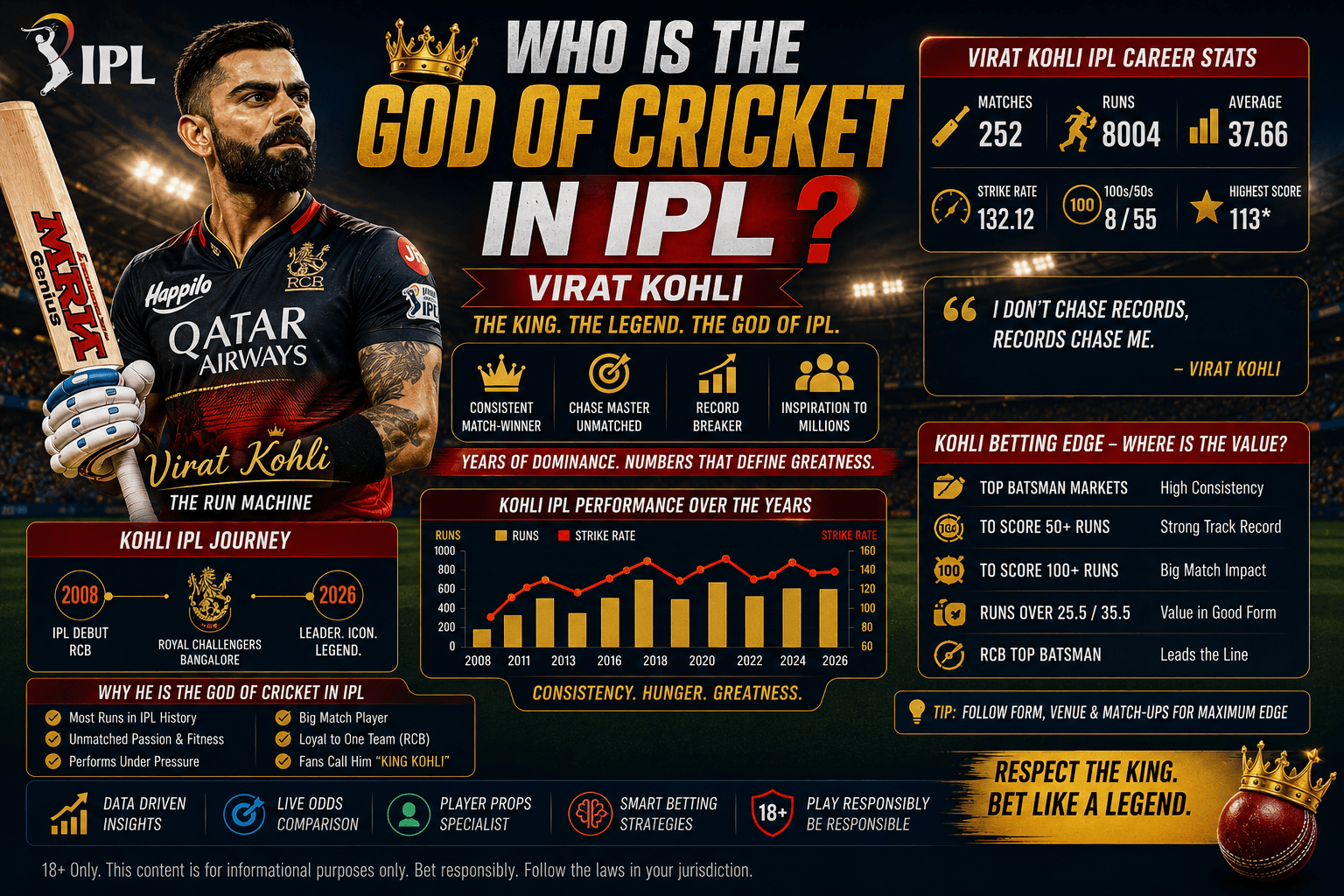
"God of cricket" is one of the most familiar honorifics in Indian sports. Sachin Tendulkar wore it for two decades across all three formats; in the IPL and T20 era, the same title has attached itself to Virat Kohli with growing frequency. The question "who is the god of cricket in IPL" is the question many fans ask first when they start following the tournament — and the answer is more useful than a piece of trivia. It tells you which player anchors the IPL's most predictable prop markets, which venue produces his most reliable returns, and which match-ups give bettors a genuine, defensible edge.
This guide covers three things: why Virat Kohli is widely called the god of cricket in IPL (the stats and the context that earned him the title), what his career profile actually looks like — runs, centuries, strike rate evolution, Chinnaswamy splits — and where that profile creates real value in IPL betting markets. We address the prop markets where Kohli is the smart pick, the matches where the price has him over-rated, and the situational filters that turn a generic "back the god" reflex into a structured betting decision.
None of this is a tip on tonight's match. It is a framework for understanding why a specific player's career profile maps to specific market opportunities — and how to recognise those opportunities when they appear during the IPL 2026 season.
Who Is Called the God of Cricket in IPL?
Virat Kohli is the player most commonly referred to as the god of cricket in IPL. The title is colloquial, not official, and it traces a clear chain of reasoning: Kohli is the IPL's all-time leading run-scorer, the only batter to play for a single franchise (Royal Challengers Bengaluru) across the tournament's entire history, the holder of the record for most centuries in IPL history, and the player who set the IPL's standalone single-season runs record in 2016 — a season that remains a statistical outlier across the league's history.
Sachin Tendulkar is the figure traditionally called god of cricket across all formats — the phrase originated in his Test-and-ODI era and remains in use for him in international cricket discourse. In the IPL-specific context, Kohli has largely inherited the title, both because of his statistical dominance of the tournament and because his career has been more concentrated in the T20 era that the IPL defined. Both attributions are common; in IPL-only conversation, Kohli is the default reference.
Why is Virat Kohli called the god of cricket in IPL?
Four reasons together explain the title in the IPL context:
- All-time IPL run-scoring record. Kohli holds the record for most career runs in IPL history by a significant margin, accumulated across every season of the tournament's existence.
- The 2016 season. Kohli scored 973 runs in IPL 2016 — the highest single-season total in IPL history. He hit four centuries in that one season, a record that has stood since.
- One-club career. Kohli has played his entire IPL career for Royal Challengers Bengaluru — a continuity unmatched at his career length in IPL history. He captained the franchise for nine seasons.
- Sustained excellence across the format's eras. Kohli has been productive across the IPL's tactical evolutions — from the early 130-strike-rate era to the modern 150-plus expectation, his output has scaled rather than fallen behind.
What is the difference between Tendulkar's and Kohli's claim to the title?
Tendulkar earned the original "god of cricket" tag across Test, ODI, and Mumbai Indians IPL cricket — primarily on the back of two decades of international dominance before T20 became cricket's defining format. Kohli's claim in the IPL specifically rests on tournament-specific records that Tendulkar does not hold: most career IPL runs, most IPL centuries, the single-season runs record. In a piece about the god of cricket in IPL, Kohli is the analytical answer; in a piece about the god of cricket in cricket, the answer is contested between the two.
What Are Virat Kohli's IPL Career Stats?
How has Kohli's strike rate evolved across his IPL career?
Kohli's strike rate has been the central tactical debate of his IPL career. In the early IPL seasons, his strike rate sat in the low-to-mid 130s — high by 2010s standards, modest by current ones. Over the last several seasons, he has visibly recalibrated, with single-season strike rates climbing well above 145 and into the 150s. This evolution matters for prop betting because the bookmaker's runs over/under lines are calibrated to recent form rather than career average — a Kohli currently striking at 155 has a different prop market profile to the Kohli of 2014.
What are Kohli's IPL stats at the Chinnaswamy Stadium?
The M. Chidambaram Stadium in Chennai and the M. Chinnaswamy Stadium in Bengaluru are two of the IPL's most distinctive venues — and Kohli's career home record at Chinnaswamy is one of his most relevant betting signals. He has scored more runs at Chinnaswamy than at any other IPL venue, with both a higher average and a higher strike rate there than at any other ground he has played at regularly. The small ground, the true bounce, and the altitude all favour his on-side stroke-play.
Editorial team: insert Kohli's Chinnaswamy-specific stats (runs, average, strike rate, centuries at the venue) from IPLT20.com or statsguru "Player vs Venue" filter.
Where Does Virat Kohli's Profile Create a Betting Edge?
Kohli's career profile creates specific, recurring opportunities in IPL betting markets — but it also creates a trap, which is that bookmakers know exactly what his profile looks like and price his markets accordingly. Finding genuine value in Kohli prop markets means looking for scenarios where his individual profile is sharper than the standard line, not just where the standard line exists.
In which IPL prop markets does Kohli offer betting value?
1. Top batsman market at Chinnaswamy. Kohli's home-venue dominance is well known, which means his top-batsman price at Chinnaswamy is usually short — often shorter than the standard opener mark of 3.50–4.50. Value emerges when the price drifts above his historical conversion rate at the venue: any time his Chinnaswamy top-batsman price climbs above 4.50 against a non-elite opposition attack, the historical record suggests the line is generous.
2. Player runs over/under in chasing scenarios. Kohli is historically among the most reliable chase batters in IPL history — multiple of his unbeaten centuries have come in successful run chases. Bookmakers know this but tend to under-adjust the runs over/under line when RCB are chasing a modest total at a venue where Kohli has historical comfort. The over is the structurally favoured side of his runs line in those specific conditions.
3. Player to score 50+ milestone markets. Kohli converts starts to fifties at one of the highest rates in IPL history. His career profile of substantial innings — rather than cameo contributions — makes the "50+ runs" milestone market a more reliable Kohli backing than the more aggressive "100+ runs" line, which has tougher historical conversion math even for the IPL's leading run-scorer.
4. Long-form innings over the season. Outright markets like "top run-scorer for the season" or "Orange Cap winner" frequently price Kohli short — sometimes too short. Across an IPL season the variance in any individual's runs total is large, and Kohli's price is often anchored to historical dominance rather than current-season form. When his pre-tournament price is significantly shorter than his current-season strike rate suggests, the value lies elsewhere on the board.
Where is Kohli over-priced or where does the market over-react?
1. Single-match top batsman on slow surfaces. Kohli's profile is built on through-the-line stroke-play. On slow, gripping surfaces like Chepauk, where the ball holds in the pitch and middle-overs spin dominates, his historical strike rate drops more sharply than the prevailing market price reflects. Top-batsman top-pick value at Chepauk is usually elsewhere in the order.
2. Sixes over/under markets. Kohli's run-scoring is more boundary-and-rotation than six-driven by historical share. His career sixes-per-innings rate is lower than the strike-rate-equivalent finishers and openers on his rough strike-rate band. Sixes over/under on Kohli often offers value on the under, particularly outside Chinnaswamy.
3. Hot-hand reaction after a big score. Bookmakers and markets tend to shorten Kohli's runs over/under by 5–10 runs after a big innings — a recency adjustment that historical data does not strongly support. Kohli's match-to-match run total has high variance like any batter's; the price often over-corrects to his most recent innings.
How should I structure a Kohli-based betting decision in 2026?
The decision-making sequence:
1. Check which venue RCB are playing at. If Chinnaswamy, the structural edge favours Kohli markets.
2. Check the pitch report. Slow, gripping pitches reduce Kohli's edge; flat tracks and true bounce enhance it.
3. Check the bowling attack. Quality left-arm pace in the Powerplay has historically been the bowling match-up that troubles Kohli most; teams without it allow him to settle into his preferred tempo.
4. Check the match state likely to unfold. Chase scenarios favour Kohli's profile; defending modest totals do not require his style of innings.
5. Compare the offered price to your conditional probability. Back Kohli markets only when the price reflects worse expectations than the conditions support.
What Makes Kohli the God of Cricket in IPL — Beyond the Stats?
The statistical case for Kohli as the IPL's defining batter is clear-cut. The cultural case — the reason the title has stuck — rests on three additional factors that shape how he is priced into markets even when raw form would suggest otherwise.
One franchise across the entire IPL era
Kohli's commitment to Royal Challengers Bengaluru across every season of his IPL career is unusual at his level of seniority and earning power. The continuity has made him synonymous with the franchise in a way no other player at his run-scoring level can claim, and it has created a betting effect: RCB's match-winner prices and Kohli's individual prop markets are tightly correlated, often more so than the math strictly supports.
Captaincy and chase-master reputation
Kohli captained RCB for nine IPL seasons, the longest single-franchise captaincy tenure of the IPL era. The combination of captaincy responsibility and his record in successful chases has built a reputation as the IPL's premier pressure batter — a reputation reflected in markets that price him as more reliable than league average in tight finishes. The reputation is broadly accurate; the market sometimes over-prices it in tight chases at less-favourable venues.
Career arc and the modern strike rate adjustment
Kohli's late-career adjustment to a higher strike rate — a deliberate response to the IPL's tactical evolution — is itself part of the case for the title. The willingness to recalibrate technique in his mid-30s rather than coast on past form is unusual at his career length. Bookmakers have followed his rising strike rate; sharper retail markets sometimes lag, which creates short-window value on his runs over/under lines early in any IPL season as the market catches up to current-form numbers.
Responsible Gambling
IPL betting carries financial risk. Set a strict deposit limit before you start. Never bet money you need for essentials. If you find yourself betting to recover losses, betting more than you planned, or hiding bets from people who would be concerned, those are warning signs.
iCall (India): 9152987821 — confidential, free counselling, available in multiple Indian languages.
Conclusion: A Stats-Led Title, Not Just a Nickname
The question "who is the god of cricket in IPL" has a defensible analytical answer in 2026: Virat Kohli, on the strength of an all-time runs record, the most centuries in IPL history, a single-season runs record that has stood for a decade, and a one-franchise career that no contemporary at his level matches. The title travels because the numbers travel with it. For bettors, the more useful question is what that profile means in practice. Kohli's career creates real, repeating value in specific prop markets — top batsman at Chinnaswamy, runs over in chasing scenarios, milestone markets on starts converted — and creates traps in others, particularly on slow pitches and in six-driven boundary markets. The framework is the same one that applies to any IPL prediction: read the conditions, compare your conditional probability to the price, and bet only where the numbers support it. Page reviewed April 2026. Career stats update with every match — refresh the placeholder values monthly during the IPL season. Always verify current operator T&Cs before placing any bet.